From: Essay X² <essayx@substack.com>
Date: Thu, May 14, 2026 at 9:34 AM
Subject: The Twelve-Point Plan to Undermine the 2026 Midterms
To: <sparrowhp3@gmail.com>

The Twelve-Point Plan to Undermine the 2026 MidtermsA plain-language guide to the coordinated effort to restrict voters, redraw power, intimidate officials, and weaken democracy before November.
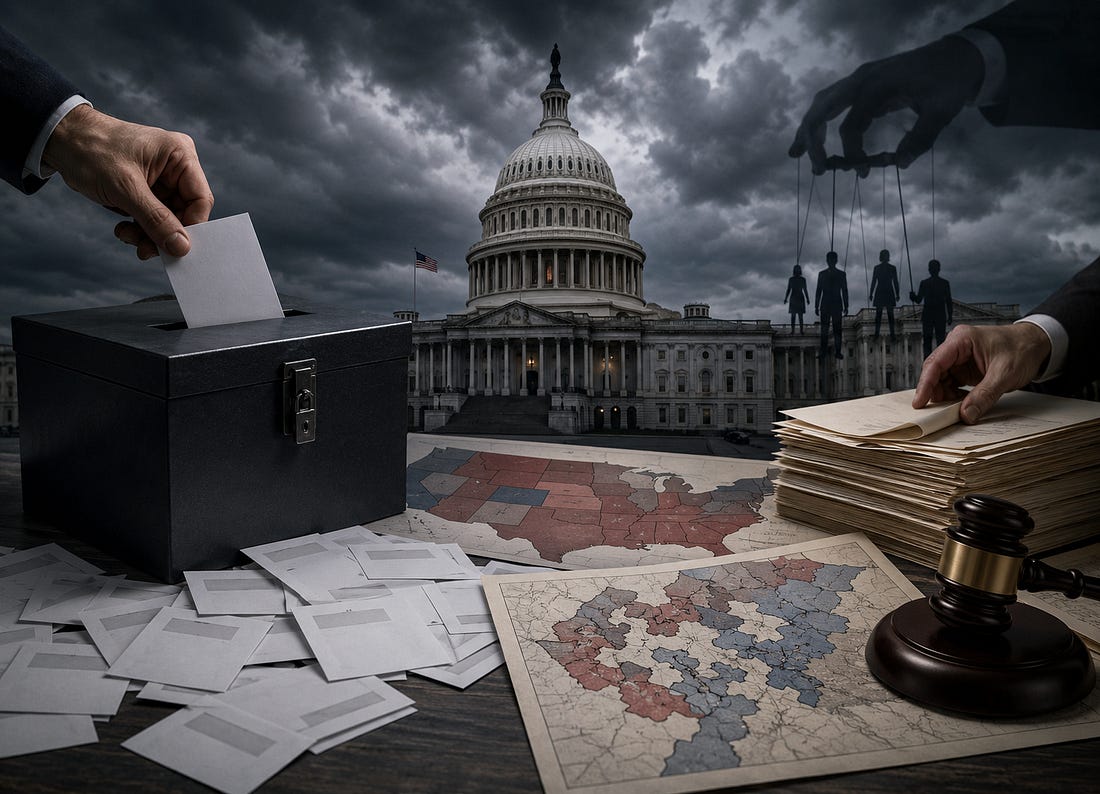
“The 2026 midterms are not being attacked in one dramatic moment. They are being attacked in stages, by changing the maps, narrowing the voter rolls, complicating registration, disrupting mail voting, intimidating officials, and preparing the fraud narrative before the votes are even cast.” As of May 14, 2026, the 2026 midterm elections are not simply a contest between Republicans and Democrats. They are becoming a test of whether American elections can still function when one political movement decides that keeping power matters more than respecting voters. That may sound dramatic, but the evidence is not hidden. Donald Trump, Republican officials, the Republican National Committee, and allied state governments are advancing a series of actions that all move in the same direction: make voting harder, make election administration more partisan, weaken protections for minority voters, intimidate election officials, and prepare the public to distrust any result Republicans do not like. This is not one single plot. It is a layered strategy. Some of it is happening through executive orders. Some of it is happening in state legislatures. Some of it is happening through courts. Some of it is happening through the Department of Justice. Some of it is happening through “election integrity” operations built on years of false claims about widespread voter fraud. The average person does not need a law degree to understand the pattern. If one side keeps trying to change who can vote, which votes count, who draws the districts, who controls voter rolls, who monitors polling places, and who certifies the results, that side is not merely campaigning. It is trying to control the machinery of democracy. Here are the twelve major fronts. 1. Redrawing congressional maps before the electionThe first major method is mid-decade gerrymandering. Congressional districts are normally redrawn after the census every ten years. Republicans are now pushing new maps in the middle of the decade, just before the 2026 elections, to protect or expand their power. Louisiana is one of the clearest examples. After a major Supreme Court ruling opened the door to new fights over racial gerrymandering, Louisiana Republicans moved toward a new congressional map that would likely reduce Black voting power and shift a Democratic seat toward Republicans. More than 42,000 voters had already cast ballots before Gov. Jeff Landry suspended U.S. House elections. That is not ordinary political competition. That is voters casting ballots, then being told the rules and the map may change underneath them. 2. Weakening Black voting powerThe second method is closely related but deserves its own attention: weakening minority representation. In Louisiana, Georgia, Alabama, Tennessee, and other states, Republican mapmaking efforts are not only about party advantage. They are also about reducing the power of Black voters and other communities that tend to vote Democratic. This matters because congressional districts determine whether communities can elect candidates who represent them. When a majority-Black district is dismantled or diluted, the issue is not just partisan math. It is democratic representation. A party that cannot win fairly in a diverse electorate has an incentive to redraw the electorate into something smaller and more favorable. That is the danger. 3. Creating proof-of-citizenship barriersThe third method is proof-of-citizenship voting requirements. Trump has made these proposals a central part of his election agenda. The stated goal is to stop noncitizens from voting. But noncitizen voting is already illegal. The real question is whether this supposed solution would block large numbers of eligible citizens. Millions of Americans do not have easy access to passports, birth certificates, naturalization papers, or documents that perfectly match their current name and address. Married women who changed their names, older voters, low-income voters, students, rural voters, and naturalized citizens are especially vulnerable to being caught in this paperwork trap. This is why voting rights advocates describe these measures as a “show your papers” approach to voting. It sounds neutral until you ask who is most likely to be blocked by the paperwork. 4. Using federal databases to question voter eligibilityThe fourth method is database matching. The administration wants to compare voter rolls against federal citizenship and immigration records. On paper, that may sound reasonable. In practice, government databases are often incomplete, outdated, or inconsistent. Naturalized citizens are especially vulnerable. A person may have become a citizen years ago, while an older database still contains outdated information. If that voter is wrongly flagged, the burden can shift to the voter to prove eligibility. That is how eligible voters can be pushed off the rolls without anyone openly saying, “We are suppressing votes.” 5. Demanding state voter-roll dataThe fifth method is a federal voter-roll data grab. The Department of Justice has been demanding unredacted voter rolls from states, including sensitive personal information. Several states have resisted. Courts have already rejected some of these demands. The danger is not only privacy. The danger is political control. Once the federal government pulls state voter data into a national enforcement system, that data can be used to pressure states, flag voters, justify purges, and create a public narrative that the rolls are filled with suspicious names. That kind of system can sound administrative while functioning as a weapon. 6. Pushing aggressive voter purgesThe sixth method is aggressive voter purging. Voter rolls do need maintenance. People move, die, or become ineligible for specific legal reasons. But there is a major difference between careful maintenance and mass purge politics. When voter-list reviews are driven by partisan pressure, flawed database matching, or panic over imaginary fraud, eligible voters can be removed. Often, they do not find out until they try to vote. By then, it may be too late to fix the problem. A purge does not need to remove every voter to change an election. It only needs to remove enough voters in the right places. 7. Disrupting mail votingThe seventh method is mail-voting disruption. Trump’s election executive order targets mail voting by attempting to impose new federal rules on ballot handling and voter verification. The risk is that the Postal Service and federal agencies could be pulled into roles that traditionally belong to state election officials. Mail voting is not some obscure convenience. It is used by seniors, disabled voters, military families, rural voters, working parents, students, and people who cannot easily stand in long lines. Restricting mail voting does not look like troops at the polls. It looks like rejected envelopes, delayed ballots, confusing instructions, missed deadlines, and voters who did everything right but still have their ballots discarded. 8. Threatening election officialsThe eighth method is intimidating election administrators. American elections are run by local officials, county clerks, registrars, poll workers, and election boards. These people are the practical backbone of democracy. Trump’s election actions, along with lawsuits and political pressure from Republican allies, have created a climate where election officials may fear investigation, prosecution, harassment, or removal. That matters. If honest officials are threatened, many will quit. Others may comply out of fear. Some may be replaced by people more loyal to a political movement than to the law. Democracy depends not only on voters. It depends on the people who count the votes. 9. Flooding polling places with partisan monitorsThe ninth method is partisan poll-watching under the banner of “election integrity.” Poll watching is legal when done properly. Both parties can observe elections under state law. But context matters. The Republican National Committee has announced a large election operation involving poll watchers, attorneys, staff, and observers in key states. In a normal political climate, that might be described as routine. But this is not a normal political climate. It comes after years of false claims about stolen elections, illegal voters, rigged machines, and corrupt election workers. In that environment, poll watching can become intimidation. It can become mass challenges. It can become harassment of voters and pressure on local officials. Transparency is good. Organized intimidation is not. 10. Trying to federalize election control through executive powerThe tenth method is using executive power to override state election authority. Under the Constitution, elections are primarily administered by states, with Congress having authority to regulate federal elections. The president does not get to rewrite voting rules by decree. Yet Trump’s executive orders attempt to push federal agencies into election administration in ways that would traditionally belong to states and Congress. This is one of the clearest warning signs. A president who wants more direct control over voter verification, mail voting, election data, and enforcement is not just expressing concern about election integrity. He is trying to move power toward himself. 11. Creating confusion before Election DayThe eleventh method is weaponized confusion. When maps change late, rules shift, ballots are delayed, elections are paused, lawsuits fly, and voters are told conflicting things, many people simply give up. Others miss deadlines. Others show up at the wrong place. Others think they are registered when they have been removed. Confusion benefits the organized and the powerful. It punishes ordinary voters. This is especially true for people who work multiple jobs, lack reliable transportation, do not have flexible schedules, or cannot spend hours decoding changing election rules. A democracy can be damaged not only by force, but by chaos. 12. Building the fraud narrative before the votes are castThe twelfth method is preemptive election denial. Trump and his allies continue to tell the public that noncitizen voting, mail fraud, corrupt officials, and suspicious voter rolls are major threats, even though widespread voter fraud has not been shown. This serves a political purpose. If Republicans win, they can say their efforts protected the election. If Republicans lose, they can say fraud must have occurred. That is not election integrity. That is an excuse prepared in advance. This is the same basic logic used in 2020: cast doubt before the election, claim victory if possible, claim fraud if necessary, then pressure the system to bend. The pattern is the pointEach tactic can be described in technical language. A map. A database. A purge. A lawsuit. An executive order. A poll-watching program. A voter-verification rule. But when viewed together, the picture is clear. This is a coordinated effort to make the electorate smaller, more intimidated, more confused, and more favorable to Republican power. It is not just campaigning. It is not just hardball. It is an attempt to reshape the conditions under which voters participate at all. The 2026 midterms are not being attacked in one dramatic moment. They are being attacked in stages. First, change the maps. Then narrow the voter rolls. Then complicate registration. Then interfere with mail voting. Then send partisan monitors. Then threaten election officials. Then claim fraud. Then litigate the result. Then use confusion as a weapon. That is how modern election subversion works. It wears a suit. It files motions. It uses words like “integrity,” “verification,” and “security.” It insists it is protecting democracy while making democracy harder to practice. The answer is not panic. The answer is clarity. Americans should check their voter registration early. They should learn their state’s voting rules now. They should vote as early as legally possible. They should help others get documents, rides, information, and support. They should pay attention to local election boards, not just national headlines. They should support honest election workers, because those workers are now on the front lines of democracy. Most of all, Americans should stop treating this as normal partisan competition. A party that trusts the people tries to win more votes. A party that fears the people tries to decide which votes count. That is what is unfolding before November 2026, and the country has no excuse for pretending it cannot see it. Before you go, tap the ❤️ and re-stack this post so we can put it in front of as many readers as possible. I know some may not want to commit to a paid subscription, but if you’d like to support my work, you can always buy me a coffee on Ko-fi. Your contribution helps sustain independent writing rooted in consciousness, compassion, and social renewal. Every bit of support truly makes a difference. You're currently a free subscriber to Essay X². For the full experience, upgrade your subscription.
© 2026 Michael Corthell
|