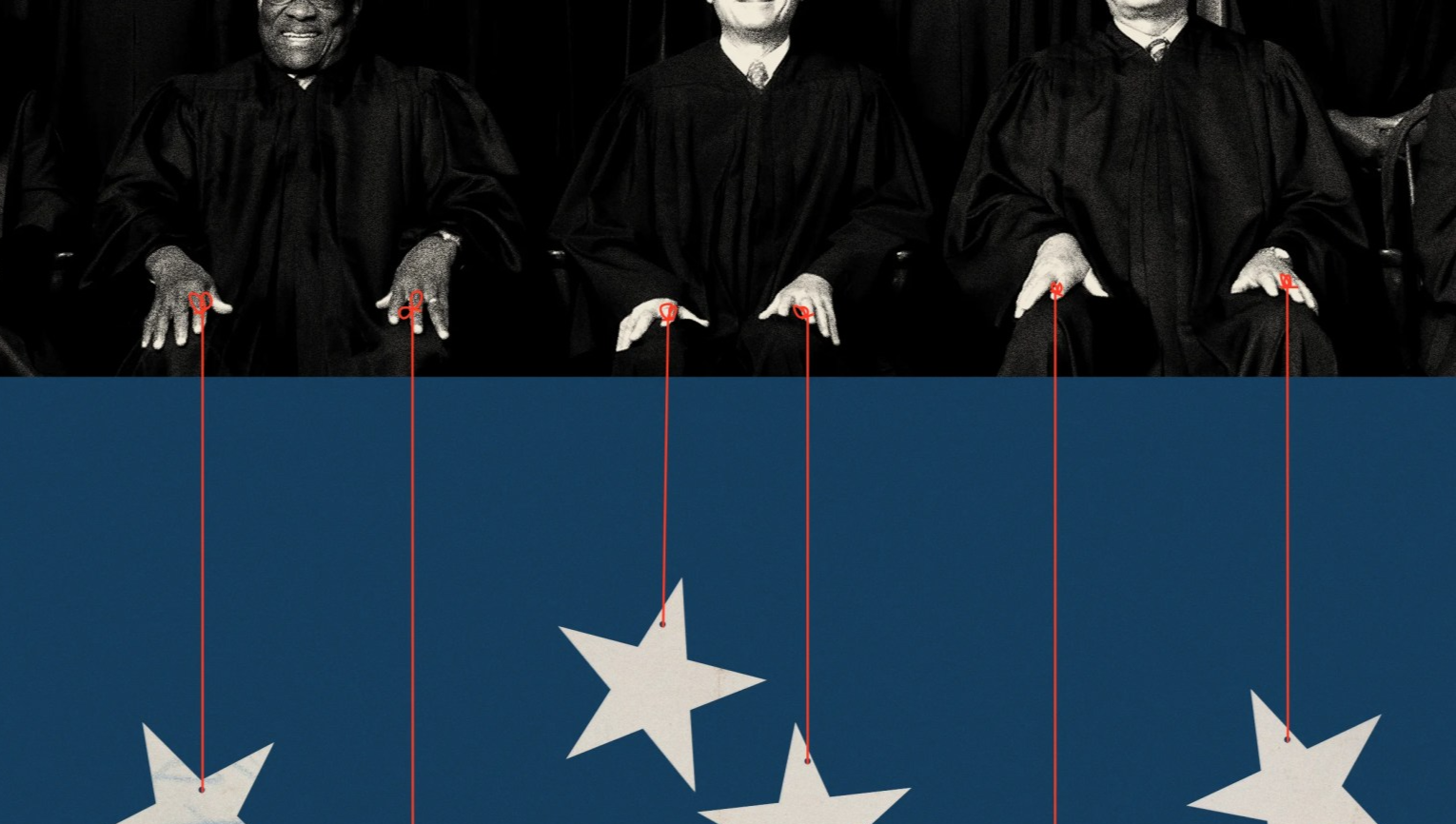
Welcome back, Deadline: Legal Newsletter readers. The Supreme Court didn’t give Donald Trump everything he asked for this term. But it gave the Republican president and his party a lot, ranging from presidential power (more of it) to immigration (less of it) to voting rights (less of them) to campaign finance rules (less of them, too) and more.
In the handful of big cases Trump lost — including tariffs (by a 6-3 vote), mail-in ballot deadlines (by a 5-4 vote) and birthright citizenship (by a 5-4 or 6-3 vote; more on the difference below) — the results said more about the extreme nature of his asks and the dissenting justices who were eager to answer them.
The birthright citizenship case is Exhibit A. It was expected that Chief Justice John Roberts would lead the court in striking down Trump’s executive order that sought to override the Constitution, federal law and precedent dating back to 1898.
The unexpected part was that Roberts spoke for only five justices when he confirmed that Trump’s order violated the constitutional guarantee of citizenship for virtually all babies born in this country.
“Citizenship, then and now, was the right to have rights — to freely participate in our political community,” the chief justice wrote, as he recalled that the framers of the Constitution’s 14th Amendment extended that promise to “every free-born person in this land.” He concluded his opinion by saying, “We keep that promise today.”
But the “we” was only a bare majority of the court: Roberts, the three Democratic appointees and Trump appointee Amy Coney Barrett. Justices Clarence Thomas, Samuel Alito and Neil Gorsuch dissented, while Justice Brett Kavanaugh was in the middle, refusing to fully join Roberts or the dissenters. Kavanaugh said Trump’s order was illegal under federal law but not under the Constitution; meaning, had Kavanaugh’s view prevailed, Congress would be free to pass a new law restricting birthright citizenship.
Under the Roberts-led view that prevailed, a constitutional amendment or new court ruling is needed to undo Tuesday’s decision in Trump v. Barbara. Until then, the promise holds. But a pledge that hinges on a one-vote margin is shaky indeed.
In the meantime, let’s be clear about what happened here. By keeping the Constitution’s citizenship promise, Roberts and Barrett didn’t turn liberal or turn against Trump or anything like that. They kept the status quo. The radical departure would have been going the route of the dissenters.
Plus, Roberts and Barrett were with their fellow GOP appointees that same day in two other big rulings: striking down campaign finance limits and upholding transgender sports bans.
The day before that, Roberts led that same 6-3 majority in the Slaughter case that overturned nearly a century of precedent in handing Trump even more power over (what were previously) independent federal agencies.
A few days before that, Roberts and Barrett joined Alito’s 6-3 rulings backing the president’s restrictionist immigration agenda, giving the government more power to end humanitarian protections and block migrants from making asylum claims.
These recent rulings followed April’s “demolition” of the Voting Rights Act, as Justice Elena Kagan put it in her dissent from Alito’s 6-3 opinion in Louisiana v. Callais. The majority went on to apply Callais in a way that further helps Republicans in November’s midterm elections, by letting Alabama use a congressional map that a lower court panel said intentionally discriminated against Black people. That lower court panel had two Trump appointees on it.
All in all, the term was a win for Trump and the GOP. To the extent that the president’s big losses repudiated him or his party, they weren’t unified pronouncements from the court, like one might have imagined the birthright citizenship ruling, especially, could have been. They were fractured rulings, over dissents from Republican-appointed justices who effectively told the country that the administration’s most far-out claims not only weren’t crazy but were, in fact, correct.
On that note, it’s worth recalling that the court sets its own agenda, so these are the cases that the court wanted to hear. The justices reject most of the thousands of petitions they receive each term. Notwithstanding the intra-GOP splits we’ve seen play out in some cases, the six-justice supermajority creates an environment for Republicans to bring appeals that previous iterations of the court wouldn’t have even considered. It takes four justices to grant review, so the three-justice minority can’t set the agenda on its own, much less control the ultimate outcomes.
A clear example of the changing court’s impact came in this week’s campaign finance case, where the majority overturned a 2001 precedent that had approved spending limits on political parties. That previous case was decided 5-4, and the only justice from that ruling still serving today is Thomas. He dissented in 2001 but was in the majority this week. His prior dissent “was persuasive in 2001 and has since been amply vindicated by this Court’s subsequent precedents,” Kavanaugh wrote for the 6-3 majority.
Of course, it wasn’t only the power of persuasion but the increased voting power of the court’s GOP-appointed majority that made this week’s ruling possible, giving Republicans yet another edge in the midterms. “Almost to flaunt the point,” Kagan wrote in her dissent, Kavanaugh’s opinion “gives pride of place to JUSTICE THOMAS’s dissent in that [2001] case; if only the rest of the majority had been there to join him!”
The justices are off the bench for the summer, but we’ll still be hearing from them before the next term starts in October. They were busy were last summer in cases backing Trump on the shadow docket. Whether this year repeats that phenomenon remains to be seen.
The court also took up new cases this week for next term. Among them are an appeal from the Republican National Committee to enforce voting restrictions in swing-state Arizona, and another one seeking a Second Amendment right to possess AR-15s and similar semiautomatic rifles. The court backed gun rights in multiple cases this term, so next term could continue that trend.
The court agreed to consider the AR-15 issue over the objection of state officials in Illinois and Connecticut, the latter of whom argued that “the public interest in avoiding mass shootings dramatically outweighs a single Petitioner’s interest in owning one more gun that he or she is unlikely to ever use for any legitimate self-defense purpose.”
The newsletter will be on hiatus until the court kicks off the next term in October, but you may hear from us over the summer. In the meantime, catch the latest on MS.NOW and the Deadline: Legal Blog, and keep your “Ask Jordan” questions coming.
Please submit them through this form for a chance to be featured in a future newsletter.